Vela Projects is proud to present Whale Fall, Emma Wootton’s debut solo exhibition.
The title refers to the ecological phenomenon that follows the death of a whale in the deep ocean. The dead mammal descends to a barren sandbank, without consequence or ceremony, before being taken apart, cell by cell, as bottom feeders, bone worms, bacteria and salt slowly devour it. The death of one whale equates to 2000 years worth of nutritional load, referred to as marine snow, birthing a surreal, submerged eco-system of creatures that feed off the whale carcass.
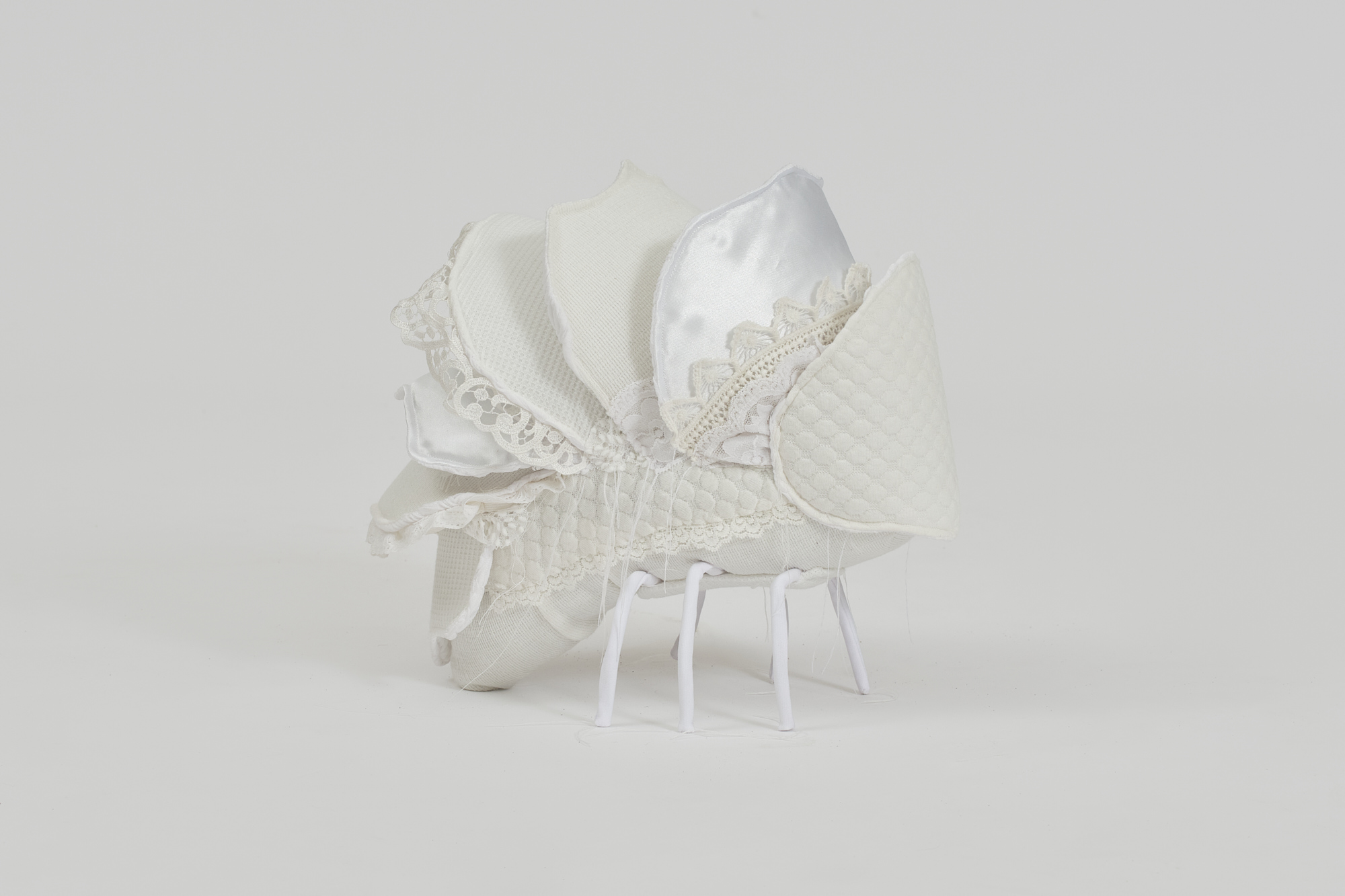
Gathered around this imagery, Wootton’s sculptures likewise inhabit a suspended moment of metamorphosis. Whale vertebrae extend from Excavator I and spill onto the gallery floor, echoing the mammoth’s carcass in death, while other creatures appear to wait their turn. These hybrid forms—part animal, part machine—scavenge the remains of this past, suggesting a condition that is either post-natural or post-human.
This unusual grouping, like the eponymous whale fall, form an oasis within a barren landscape. Their colour, or lack thereof, evokes an in-between state: like bleached coral, neither fully dead nor alive, but suspended—waiting for either recovery or deterioration.
In these sculptures birds and insects are merged with machinery, both forms are evidence of mutual encroachment. Speaking on these choices:
Birds and insects are interesting as they both face severe threats of extinction and habitat loss, but at the same time many can be found to be thriving in new urban environments; I am thinking here about pigeons, cockroaches, crows and other scavengers.
Wootton’s hybrids–these middleground beings, inspired by animals typically thought of as pests–confront our desire for clear distinctions between the natural and man-made worlds we make and destroy. Simultaneously, they emphasize our inability to distinguish between the two; a refusal to acknowledge the natural world as part of the man-made, and vice versa. This begs the question, how might this discomfort be absorbed, overcome, circulated, and even put to work - kept in motion, like decay, towards something generative?
And so, Wootton’s sculptures can be read as experiments in materialising concerns into something softer,
To me, climate change exists as a kind of cosmic horror, something too massive and intangible to be affected or even truly visualised by an individual.
The overwhelming nature of this knowledge reflects not only concerns about the broader environmental crisis, but reveals something about the nature of fear itself–namely its perception as an ‘abstract, looming thing’.
Fear is often an emotion that causes you to hide, to avoid doing things, and to despair.
Working with an array of white fabric, lace, linen, cotton, and satin, materials known for their delicacy, Wootton gives form to these abstract horrors - rendering anxiety into something productive and playful. This gentle approach, personified by the fabric, sometimes frayed, always monochrome, seamlessly creates a new kind of species: Creature II is a composite of a two-headed fly with the body of an eagle, while Creature I’s head is a hydraulic grabber and vulture. The peacock, an historical thing of beauty in Creature III, becomes morphed with additional appendages: arms inspired by praying mantis’ and a gear cog from an unknown scrapped machine. These creatures, for all their contradictions, make, as Wootton suggests, “a fatalist future seem less certain.”
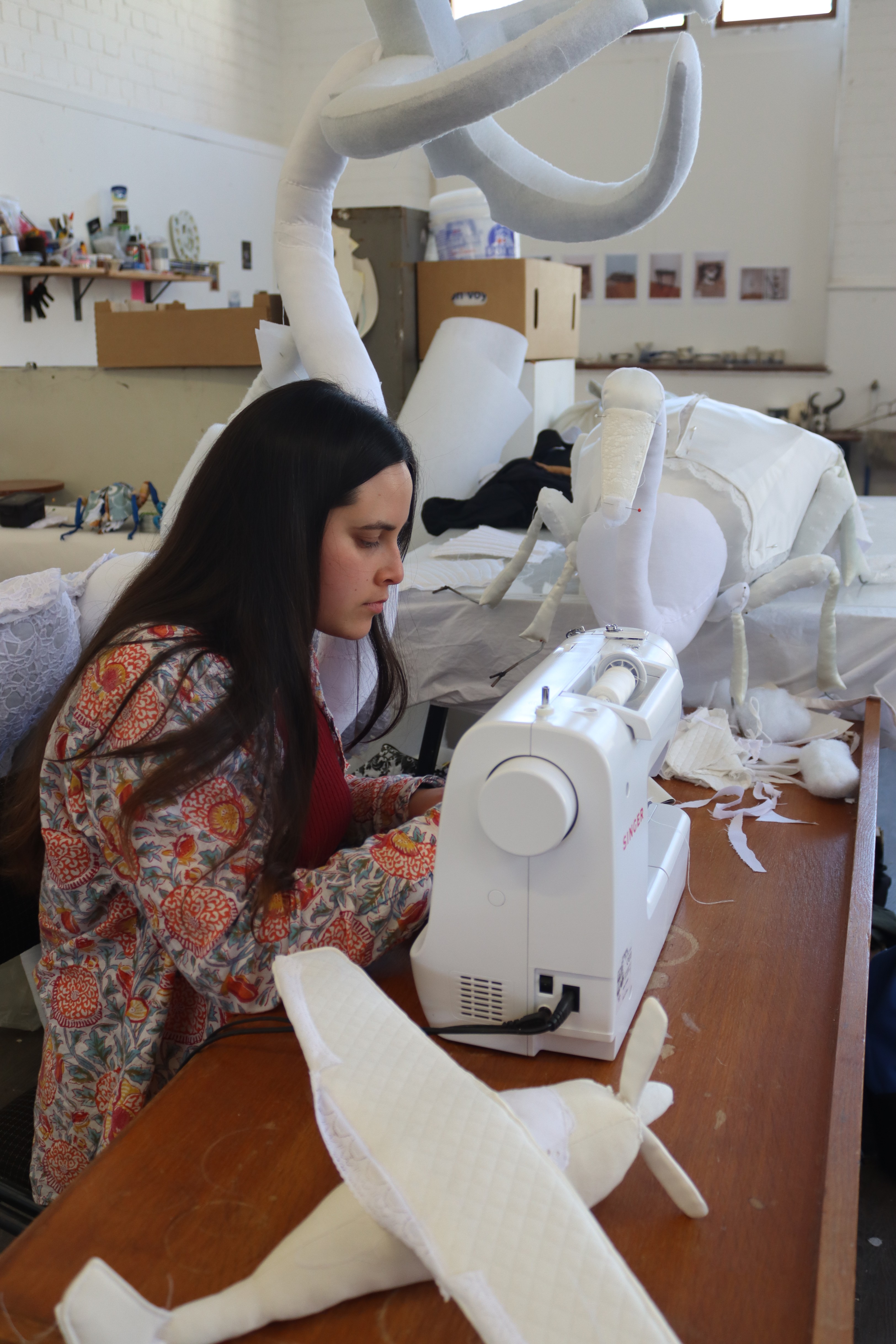
In making the idea of an abstract horror tangible, Wootton both minimises the threat and confronts it. Wootton, learnt to sew as a child, often making soft toys for herself – a skill that translates into masterful joinery, mimicry, and whimsy, and a nimbleness of repeated action, small stitches, that in their totality make metal limp, and fabric hard. Wootton employs a Mary Shelley-like approach to her sculptures – a laborious, quiet practice of forming muscles, or remoulding of flesh – subverting domestic scenes of mending and adornment into something chilling. Wootton, therefore, shifts the sculpture’s code from destruction to innocence. And in doing so, it foregrounds endurance and fragility, or a threadbare distinction between worry and thrill.
And so, amongst the padding, one is left with the idea of redemption for these creatures. And while there are implied markers of doom and anxiety, horrors in the making, Wootton rejects fatalism in favour of agency through acts of considered making and repurposing materials. Donna Haraway writes, in her Companion Species Manifesto (2003), that our relationship with companion species, our pets, our monsters, is "not especially nice; it is full of waste, cruelty, indifference... as well as of joy”. Wootton’s sculptures encompass the spectrum and do not beg to be saved or returned to a natural state. Rather, they sit within the trouble and uncertainty of their categorisation, past the reaction of fight, flight and fawn, and toward a state of responsiveness. Quietly, and collectively, they emit and absorb whatever we throw at them, so that softness is not just a texture but a state.