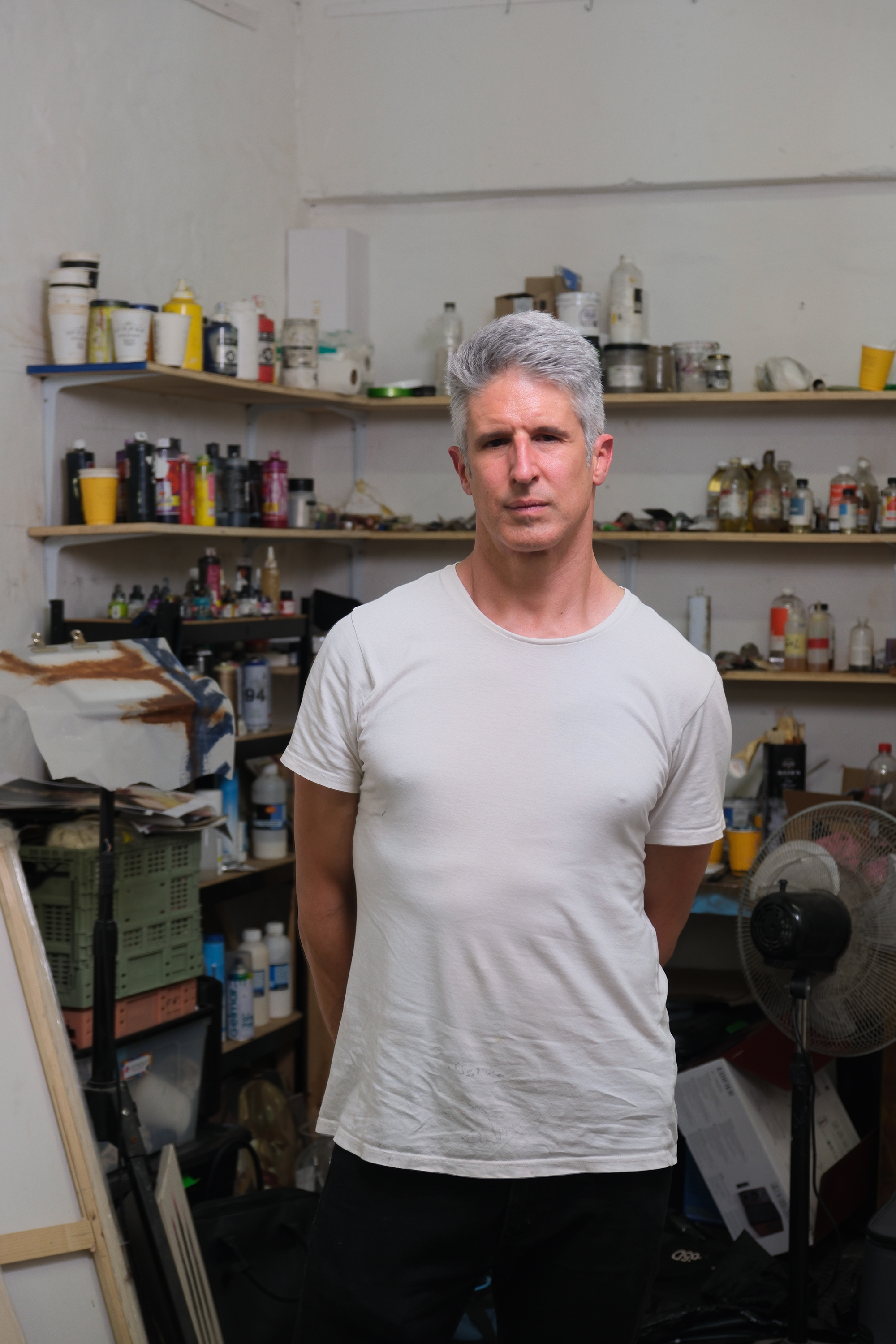
Vela Projects is proud to present Transcription, a solo exhibition by Alexis Schofield. Born and raised in Pretoria, Schofield currently lives and works in Cape Town, South Africa.
Exhibition text by Alexis Schofield
So God created man in his own image, in the image of God he created him; male and female he created them. — Genesis 1:27
Having spent years working with AI image generation, my relationship to it has fundamentally changed. When I began to use it as a tool to generate reference material for paintings, the quality was pretty bad. Nonetheless, I found it interesting. Its bizarre aesthetic seemed to me to be indicative of the artificiality and bizarre. I drew compositions and then uploaded them, asking the AI to generatea subject in that pose which I would use as a reference, the same way a 19th century artist would use a model.
AI has been trained on mountains of imagery from the internet, and so is constantly trying to give you what it thinks you want, which is often very mundane imagery that you would find in console games, comic books, or fashion magazines. I discovered that, when creating reference folders from which the AI could draw, the use of religious imagery, such as the Pietà, gave me the most interesting results. I think part of what makes painting such a unique glimpse into an erais its choice of materials. Consider Velázquez’s The Waterseller of Seville or The Coronation of Napoleon by Jacques-Louis David. The water droplets on the clay jug, the ornate furs and feathers - these textures reveal the world in which it was painted. I feel the textures which best emblematise our era are the artificial, synthetic and cheap.
Thus, I added to the reference folders images and textures that looked synthetic, such as plastics and shiny materials. This was also influenced by social media filters that made everything sparkle. I also included screen grabs from South African TV news, current affairs, war, or other imagery I found interesting, including some personal photography. For instance, I was recently fascinated by images of rocket launches, be they space rockets or ballistic missiles. This practice created a snapshot of my interests for the machine to reference, very much like a wall of references. These folders, over the years, have become more complex and use imagery generated from previous style folders. What exists now is a history of my relationship with the machine, which it is using to generate new images.
The machine has no image of its own, since its mode is to replicate. It has no real conception of the human form either, only a code whose pattern relates to one. I found my mode of working beginning to form an attempt to prompt the machine to picture itself. The result follows the logic of creating an icon of a deity, where something without form is give none. Religious icons have always done so in human terms, since God made us in his likeness: Imago Dei. Beyond images of data centres, circuit boards or futuristic androids, what has been created here is something in our of form, Imago Hominis. The machine is designed to form a human interface, and so the computer programme transcribes that code into an image, which I render onto canvas. Because it draws on my personal history of images, that form also carries traces of me, and our relationship. The machine's image of itself thus becomes, by inference, an image of me.