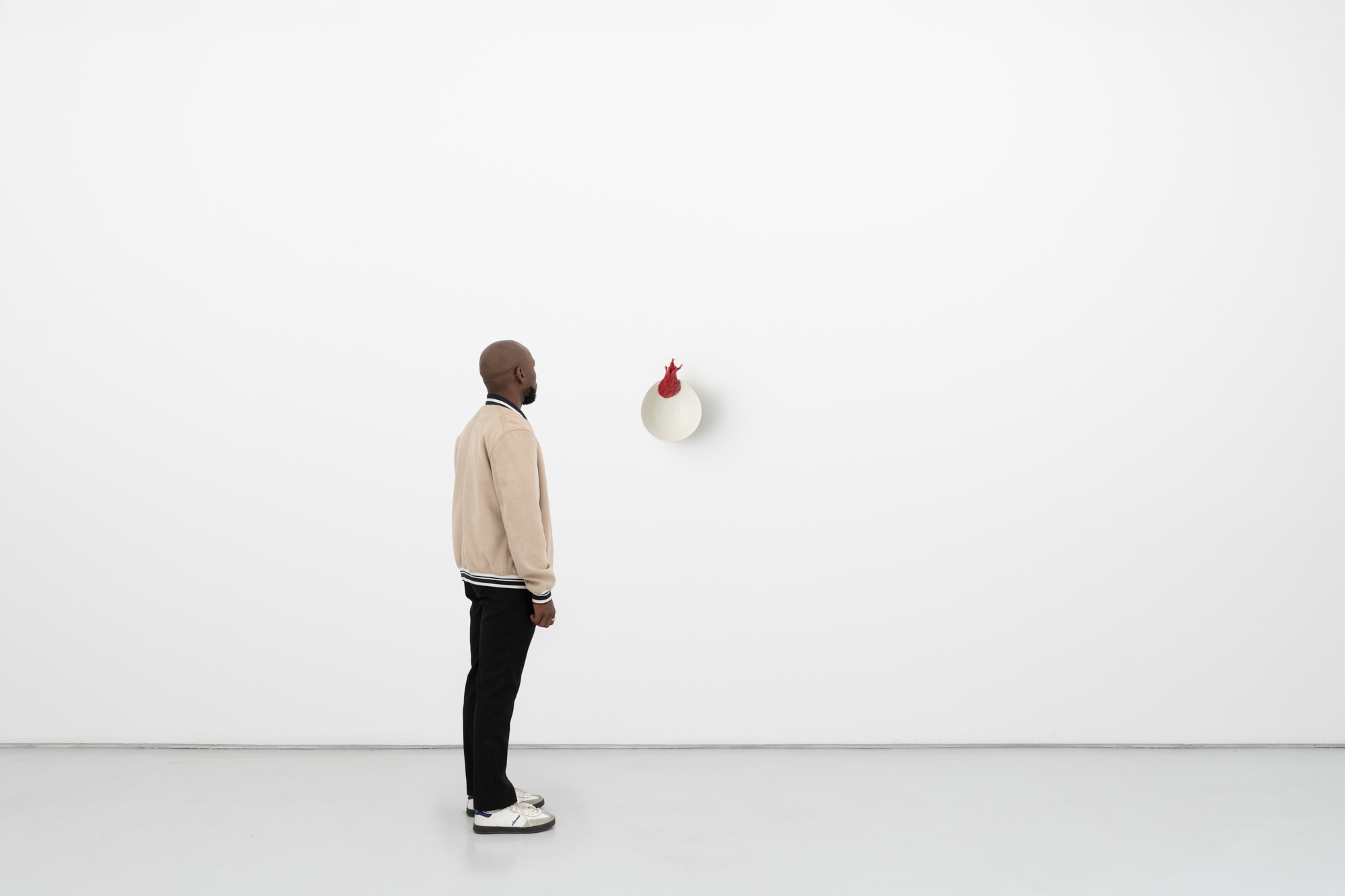
Vela Projects presents Pour, an exhibition of new ceramic sculptures by Dominic Pretorius.
Exhibition text by Lucienne Bestall
A year ago, almost to the date, Dominic Pretorius sent me the first letter in what would become a sustained correspondence between us. It was an invitation to accompany him as interlocutor as he sought a language for what he was making, a missive against the muteness that had descended on him following the dissolution of his marriage. “The silence can be heard, or rather felt, to ripple,” he wrote. “I’ve spent months sculpting the invisible undercurrents.” His reticence soon became an upwelling of words, to which I replied, finding confluences with his preoccupations. We exchanged dozens of letters about art, psychoanalysis, God, and above all passion. If the premise of our correspondence had been to better equip me to write a text for Dominic’s exhibition, it has perhaps undermined its own end. I know too much; the words, having overflowed, now run dry. And yet, in my duty to distil –
Pour traces the transition between states. There is the alchemy proper to the artist’s medium, the mud of clay transfigured by fire into mineral permanence. There is the despondent darkness with which Dominic first embarked on shaping the works included in this exhibition, and the candescent clarity that marks its resolution. And there is then that more subtle shift, which sanctifies ordinary attention and action, recasts the repeated gesture as ritual.
Pour is a study in risk and resolve – that of the ceramicist’s labour, and that of being in relation to others. Love is always attended by loss, a haunting Dominic recognises in the very materiality of his practice, writing in one December letter:
Everything formed in wet clay is merely a possibility. It takes the pieces a long time to dry, to finesse, to bisque fire, to glaze, and a strong attachment is formed to them during this time. Some break during this passage. It’s strange never knowing which ones will survive; before they break, each must receive the equal amount of attention and care, as if they will be forever. And then, you must offer those that remain up willingly to be tested in the final firing. All may seem right when they enter the kiln – no visible cracks, well-applied glaze – and disappear in the blinding light of the heat. There’s nothing quite like the dawn-opening of a kiln after months of work. Have they survived the night?
For Dominic, Pour ultimately turns on sex, on passion’s conflation of pleasure and pain, its confusion of edges, the overspilling of boundaries that the act exacts. But, in the same breath: Pour is at once a supplication and consecration. Meditations on the divine have attended the artist’s bloodied bowls and hollow, bell-like droplets from their very beginning. Our exchange began with a religious hymn, which, as Dominic wrote, “returns to, clings to, a devotional refrain.” The same might be said of this exhibition. Pour counterposes flesh and faith, embodied weight and spiritual weightlessness, substance and transcendence. The brilliant blood in Dominic’s white vessels rises heavenwards, aspires upwards; his celadon droplets of water, while subject to gravity, meet their own reflection, falling in the opposite direction. His resounding conviction is that it remains possible – even if only for a suspended moment – to make that which is heavy light and lambent.
As his final word in our exchange, offered in a parting postscript, Dominic sent me effusive, accompanied by its geological definition: (of igneous rock) poured out when molten and later solidified. The exhibition mirrors this movement: the spilling indeterminacies of sex and sorrow, their excess and outpouring, coagulating into silted stillness. Pour is an effusion: of blood and water and all the many fluids that mark out our intimacies and stain our souls – ineffably, indelibly.
“I have come to understand that eros is a mean mix of grief and desire,” Dominic wrote –
what is lost might be had / what might be had is lost.
Our correspondence is reproduced in a modest volume, One Half Runs Water / The Other Runs Blood, published to coincide with Pour.